Business profiles in ChatGPT: what short-term rentals should know
OpenAI opened business profiles this week. For independent properties, the real question comes before the form.
Picture someone planning a getaway.
They don't know exactly which neighborhood they want to stay in. They don't have a property in mind. What they do know is how they want the trip to feel.
They could open Airbnb or Booking.com, apply a few filters and scroll through hundreds of listings.
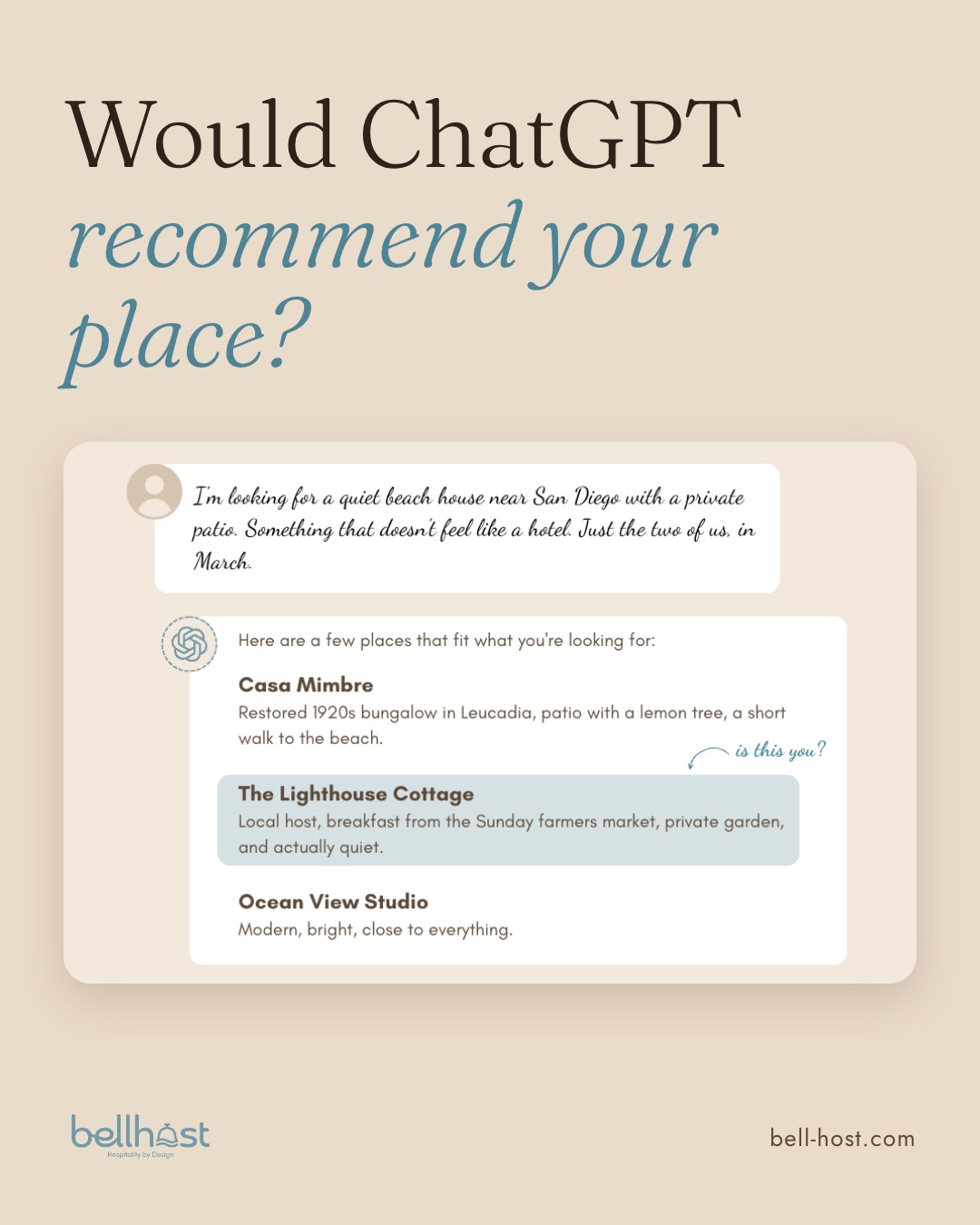
Or they could open ChatGPT and type:
“I'm looking for a quiet beach house near San Diego with a private patio. Something that doesn't feel like a hotel. Just the two of us, in March.”
They're not simply looking for a two-bedroom with a full kitchen and parking.
They're describing an experience.
And that raises a question for anyone who runs a place to stay, whether it's a short-term rental, a boutique hotel or a hostel: what information exists about your property that lets a person, or an AI tool, understand what makes it different?
What changed this week
On November 10, 2026, OpenAI introduced Businesses in ChatGPT, a new beta program.
Through Business Hub, owners or authorized representatives of eligible businesses can claim and verify a profile, keep their information up to date, and see aggregate stats on mentions, clicks to their website and the topics connected to how they're discovered.
Some businesses can also set up a Business Agent: a labeled chat, separate from ChatGPT's regular answers, where people can ask questions about what a business offers. It's free for now.
Access still depends on the business's category and location. Business Agents, in particular, are initially available for certain U.S. e-commerce and online service businesses.
And signing up isn't enough. OpenAI lets you verify a business by business phone, email, website domain or Shopify, depending on the case, and it also requires an additional identity check through Persona, a third-party service.
It's also worth being clear about what doesn't change.
- It doesn't guarantee more recommendations. Claiming a profile doesn't mean ChatGPT will recommend your property or mention it more often. Its answers are still built independently, from a range of sources.
- It isn't a booking engine. It lets you manage business information and, where eligible, offer an agent that answers questions. It doesn't automatically make a property bookable inside ChatGPT.
- Travel was already exploring this space. Booking.com and Expedia have apps inside ChatGPT. And since March 2026, Lighthouse's The Hotels Network lets participating hotels show up-to-date information and rates and send travelers to their websites to complete the booking.
The simplest way to see it: ChatGPT can become another discovery point for a property. A search can start with a conversation and end on a booking platform or on the property's own website.
My experience
I wanted to see how Business Hub works from the inside, so I started setting up Bellhost's profile.
I was able to fill in the business information and verify my website domain. My registration is now waiting on the identity check, so I don't have a published profile yet.
The form asks for a category, a short description, and shipping and return policies: fields that look built for stores. A host is left to decide on their own what goes there.
And that got me thinking about something much bigger than the form.
If you had a few lines to explain your property to someone who had never heard of it, what would you say?
The number of rooms? The amenities? The location?
Or could you communicate something that truly sets it apart?
Guests can now describe what they want
For years, most of the search for places to stay has been organized around destinations, dates, prices and filters.
How many guests? How many bedrooms? Pool? Pets?
All of that still matters.
But a conversation lets people express something filters don't always capture: the intent behind the trip.
One person wants a small hotel to rest in after a long hike. Another wants a hostel where they can meet people without giving up a good night's sleep. A couple would rather have a house with personality near the ocean than a bigger place with a long list of amenities.
That doesn't mean traditional platforms are on their way out. According to a YouGov survey for Expedia Group (March 2026), only 8% of travelers in the U.S. and U.K. use AI chatbots or agents to plan a trip. Familiar tools still lead.
Conversational search is still evolving. But it already offers a different way to discover places: starting from what a person wants to experience, not only from a property's features.
Let's imagine three made-up properties that could answer the search from that couple who want to stay near the ocean in San Diego.
Casa Mimbre
A restored 1920s bungalow in Leucadia, with a lemon tree in the patio and the beach a short walk away.
The Lighthouse Cottage
A small house with a local host, breakfast from the Sunday farmers market, a private garden, and the kind of quiet guests mention in their reviews.
Ocean View Studio
Modern, bright, close to everything.
All three descriptions give you information. But they don't say the same thing.
With the first two, we can start to picture the stay: how the space feels, how it relates to its surroundings, and what would make it right for a certain traveler.
The third could describe an excellent property. It could also describe hundreds of others.
That doesn't mean ChatGPT would automatically recommend the first two. We don't know every factor that goes into its answers.
What we do know is this: the clearer and more specific the information about a property, the easier it is to understand what it offers and who it's for.
And the same is true when the reader is a person browsing Airbnb or Booking.com.
Start with what you're saying today
It's tempting to read this news as one more technical chore: open another profile, fill in fields and hope to show up in searches.
But there's a question that comes first.
What is your property communicating today?
Think of a small cabin surrounded by forest.
Its listing mentions wifi, a full kitchen, air conditioning, parking and a queen bed. All of that belongs. Guests need to know it.
But what people remember after staying might be something else: waking up to birdsong, having breakfast on a deck that faces the trees, or finding a trail that starts behind the property.
If those details are real and part of the stay, why aren't they in the description?
The same goes for a hostel whose greatest strength is the community that forms around its shared kitchen, or a guesthouse where the host knows every corner of the neighborhood.
It's not about inventing stories or filling listings with adjectives. It's about recognizing what's valuable in each place and communicating it concretely.
And that identity has to hold up at every touchpoint: photos, descriptions, reviews, messages, arrival information and the experience the guest actually lives.
A retreat marketed as peaceful can't have rooms facing a noisy street. A property that promises personal attention shouldn't greet guests with confusing, impersonal instructions.
Differentiation can't stop at the listing. It has to be felt during the stay.
Ask yourself
Before you think about how to show up in ChatGPT, look at how you present your property today.
- Could your current description be used for the property next door without anyone noticing the difference?
- What do guests mention in their reviews that your listing doesn't say yet?
- Do your photos, description, messages and the real experience tell a coherent story?
We don't know yet how much weight Business Hub will carry in how independent properties are discovered, or what features will be added. A verified profile also doesn't replace positioning, quality of service or a well-built commercial presentation.
But OpenAI's announcement points in a direction worth watching: travelers can already start looking for a place by describing the stay they imagine, without necessarily having a property or even a destination in mind.
For independent properties, this reinforces something that has always mattered: understanding what experience they can offer, what sets them apart from the alternatives, and how to communicate it clearly.
Not because a good description guarantees showing up in ChatGPT. But because a property that knows what makes it valuable has more tools to communicate it, whichever channel its next guest comes through.
The goal isn't only for people to find your property. It's to give them a reason to choose it.
Sources
- OpenAI, Introducing Businesses in ChatGPT (November 10, 2026)
- OpenAI, Setting up your business on ChatGPT
- OpenAI, Businesses in ChatGPT Policy
- OpenAI, Introducing apps in ChatGPT
- Lighthouse, The first direct booking app for hotels launches in ChatGPT (March 4, 2026)
- Expedia Group, The AI Trust Gap (April 2026)
The information about Businesses in ChatGPT reflects what was announced and documented as of November 11, 2026. Beta terms may change.

Written by Yanina A.
Founder, Bellhost